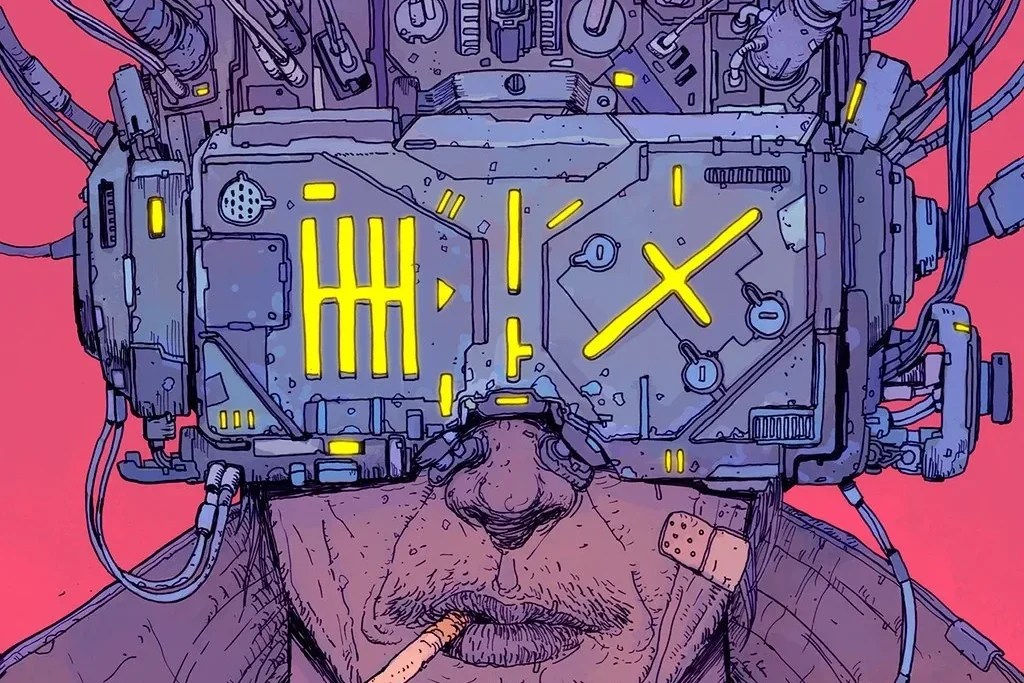
Josan Gonzalez’s cover art for the novel Neuromancer by William Gibson
“When the past is always with you, it may as well be present; and if it is present, it will be future as well.”
In Jack Womack’s afterward to the novel Neuromancer by William Gibson, he presents his view that the novel’s groundedness and depth come in part from the way it connects with timeless aspects and artifacts of human experience. That’s one of the many reasons Neuromancer is among my favorite novels, because at its core the book tells a human story which happens to occur in the context of AI, virtual realities, and—above all—brain-computer interfaces (BCIs).
Neurotechnology has been a passion of mine for over a decade, though its only the past couple years that I’ve had the opportunity to do research on the subject. If you aren’t aware of the changes happening in the field in recent decades, I have to tell you, it’s nothing short of extraordinary. The following is by no means an exhaustive list, and simply reflects the hardware and companies with which I’m personally more familiar. That said, they and many others are making immense progress.
Existing approaches are being modified and significantly upgraded, like Paradromics‘ impressively compact, pea-sized implant or Precision Neuroscience‘s epidural microelectrode arrays, the latter of which recently set the record for the greatest number of electrical leads in an implantable BCI by networking multiple copies of their device together. Interesting twists on traditional electrical hardware are already well into human clinical trials, like Synchron‘s Stentrode, a device which is implanted as a stent into large blood vessels in the brain and provides electrical readout and stimulation to the corresponding local region. Other technologies leverage entirely different branches of physics which have never before been used for clinical neurotechnology, such as the rapid progress Forest Neurotech—led bySumner L Norman, Will Biederman, and Tyson Aflalo—and others have been making in developing focused ultrasound for brain stimulation devices. Another particularly inventive and exciting technology is that of NeuroBionics, where MJ Antonini and Nicolette Driscoll have built a company around their invention of microns-thin, flexible polymer wires which can safely be implanted into the blood vessels of the brain, capable of simultaneously delivering medications and performing optical stimulation, electrical stimulation, and electrical recording all in the same device.
BCIs already allow people to use computers, write text, and generate synthetic speech via nothing except measurements of their brain activity. Complexity and capabilities in this space are rocketing forward, and we’re approaching a point where BCIs capable of virtually whole-brain readout and modulation may be possible. The devices I listed as examples above are also notable in being far safer to implant than traditional deep-brain stimulation hardware, and I anticipate the safety profile of BCIs to continue improving.
This confluence of safety and capability in BCIs means that it will be used for more and more tasks by an ever-growing number of people. I doubt anyone can currently predict the full breadth of the positive impacts this will have on the lives of patients and their loved ones, as well as society more broadly.
However, amidst all the completely justified excitement regarding this progress, there’s a flip side to the technology which I virtually never see discussed: information security.
Future BCIs—and to a significant degree current ones as well—will handle information representing the most private and intimate parts of who we are as human beings. Our thoughts, our very identities in their totality, will have new ways to interact with the world around us, for the first time in our species’ history expanding beyond the types of capabilities evolution itself provided to us. Devices capable of translating brain activity into text or speech are already, quite literally, reading some portion of the person’s thoughts. Yet whenever you have a piece of computing hardware with valuable information, there’s an incentive to steal that information.
As the technology becomes safer and more powerful, and thus finds itself in more brains and with access to more information in each brain, the value of methods for hacking them increases. For devices which both record and stimulate, there will also be the possibility of implanting information, though the potential precision and efficacy of such an action is currently unclear and hard to predict. Information richness makes all the difference. A hypothetical device which outputs the probability of someone having a seizure in the next minute won’t be providing data worth much of anything to potential hackers. A device which outputs your thoughts in detail, or is capable of modifying them with any non-trivial efficacy, is an almost incalculably valuable target for would-be brainjackers (the term from the research literature on the subject).
My mention of Neuromancer is relevant beyond the similar themes, as I was rereading the novel in late 2022 when I started to wonder what the mathematical features of such security problems would be. It turned out that in the roughly 15 years since the first paper on the subject, there had been shockingly little research on the whole. I’m talking a couple dozen papers total on a subject which will soon be of immense practical, medical, and societal concern. Of that, only a couple had done any work studying the problem in terms of computational and information properties, which is at the core of figuring out how one could even begin developing security methods deserving of meaningful confidence. I’m not going to discuss my work on the topic here, because my goal with this post is to generate awareness and interest in neurotech security and neurotech as a whole. Neurosecurity is currently a massive gap in the scientific, engineering, mathematics, and computing literature, and we urgently need more people thinking about and working on it.
Possibilities previously relegated to the realm of science fiction will soon begin impacting us in remarkable ways. Paralyzed patients regaining so much of what they’d lost to injury or disease. Improvement for brain injuries once completely untreatable. Better management of chronic and severe psychiatric conditions. Countless millions stand to experience profound and life-changing benefits. Inherently, these benefits carry with them the risk of dangers which until recently have also existed solely within the purview of sci-fi. Theft of human thought and identity at a neurological level. Alteration of the probability of someone making one decision over another, or of the odds their beliefs will change in different directions. Fraud via man-in-the-middle attacks targeting one’s brain or the portion of a device which converts the neural activity readings into a computer output. These are all closely akin to things we’ve seen before, in an astonishingly broad and sophisticated collection of methods developed for cyberattacks on all manner of computing devices. Hackers target everything from data centers and government labs to personal computers, robot vacuums, and even children’s toys. Believing that BCIs would somehow be exempt from this is completely absurd. As Jack Womack said, when the past is always with us, it will be our future as well.
Contemporary neurotechnology is already incredible, and is progressing at an astonishing pace. This field will change countless lives in extraordinary ways, and has the potential to change the world. We need to make sure that the science of how to keep them safe is ready before future threats become very present ones.
Originally posted to LinkedIn, April 10, 2025
 The Postdisciplinary Blog
Leave a comment